FP1 vs FP3: What Is the Difference in Full-Arch Dental Implants?
FP1 replaces the teeth only. FP3 replaces the teeth and prosthetically restores the contour of lost hard and soft tissues with a pink component. The correct choice depends on the patient's anatomy and on what can be reconstructed predictably, not simply on preference or cost.
Patients researching fixed full-arch implant treatment often encounter two terms: FP1 and FP3. They describe different relationships between the prosthesis and the surrounding tissues. Neither is inherently better. Each is appropriate for a different anatomical situation.
What is an FP1 prosthesis?
FP stands for fixed prosthesis. An FP1 restoration replaces only the clinical crowns, meaning the visible teeth. It contains no artificial gingiva. In the mouth, the teeth appear to emerge directly from the patient's own gingiva, in the same way as natural teeth.
This transition is demanding. It requires favourable, or predictably reconstructable, bone and soft-tissue conditions, together with prosthetically driven implant positioning. Many FP1 cases require deliberate hard- and soft-tissue management, before or during surgery. The provisional restoration also plays an important role: it helps shape and test the tissue frame before the definitive prosthesis is made.
There is very little room to conceal a compromise. Every millimetre of planning can affect the final transition from gingiva to tooth.
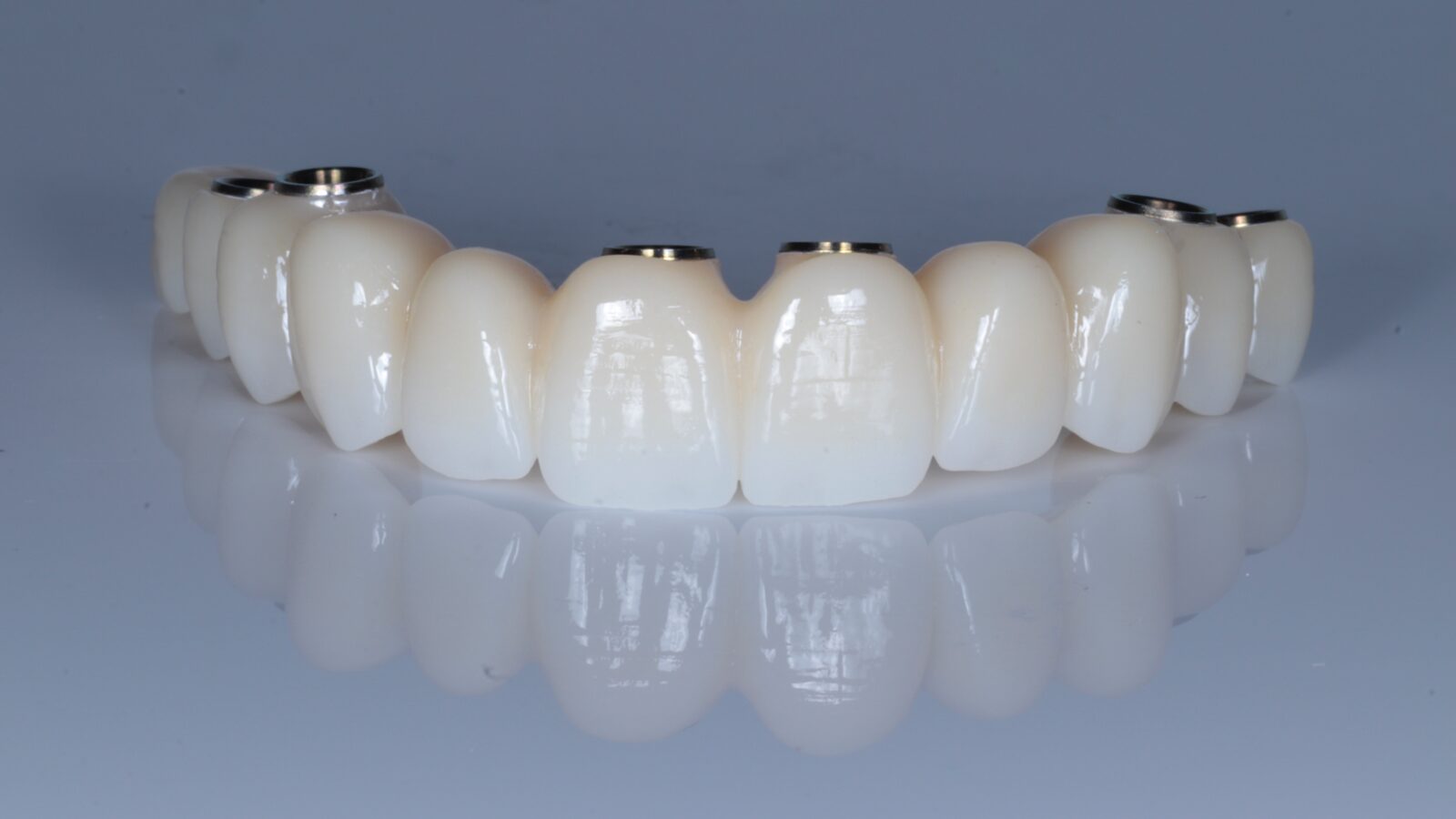
Figure 1. FP1 prosthesis: teeth only, with no pink gingival component. Clinical image by Dr Miguel Mendes de Oliveira, published with patient consent.
What is an FP3 prosthesis?
An FP3 restoration replaces the teeth and prosthetically restores the contour of lost hard and soft tissues. A pink ceramic or composite component is incorporated into the prosthesis to reproduce the missing gingival volume.
FP3 is commonly considered when there has been moderate to advanced ridge loss following long-standing tooth loss, periodontal disease or surgical bone reduction. It can restore dental proportions, lip support and facial volume that an FP1 prosthesis cannot provide on its own.
FP3 is not a lesser treatment. It is an established solution for a specific anatomical situation. It becomes the wrong choice only when it is prescribed for anatomy that did not require a prosthetic replacement of the gingival contour.
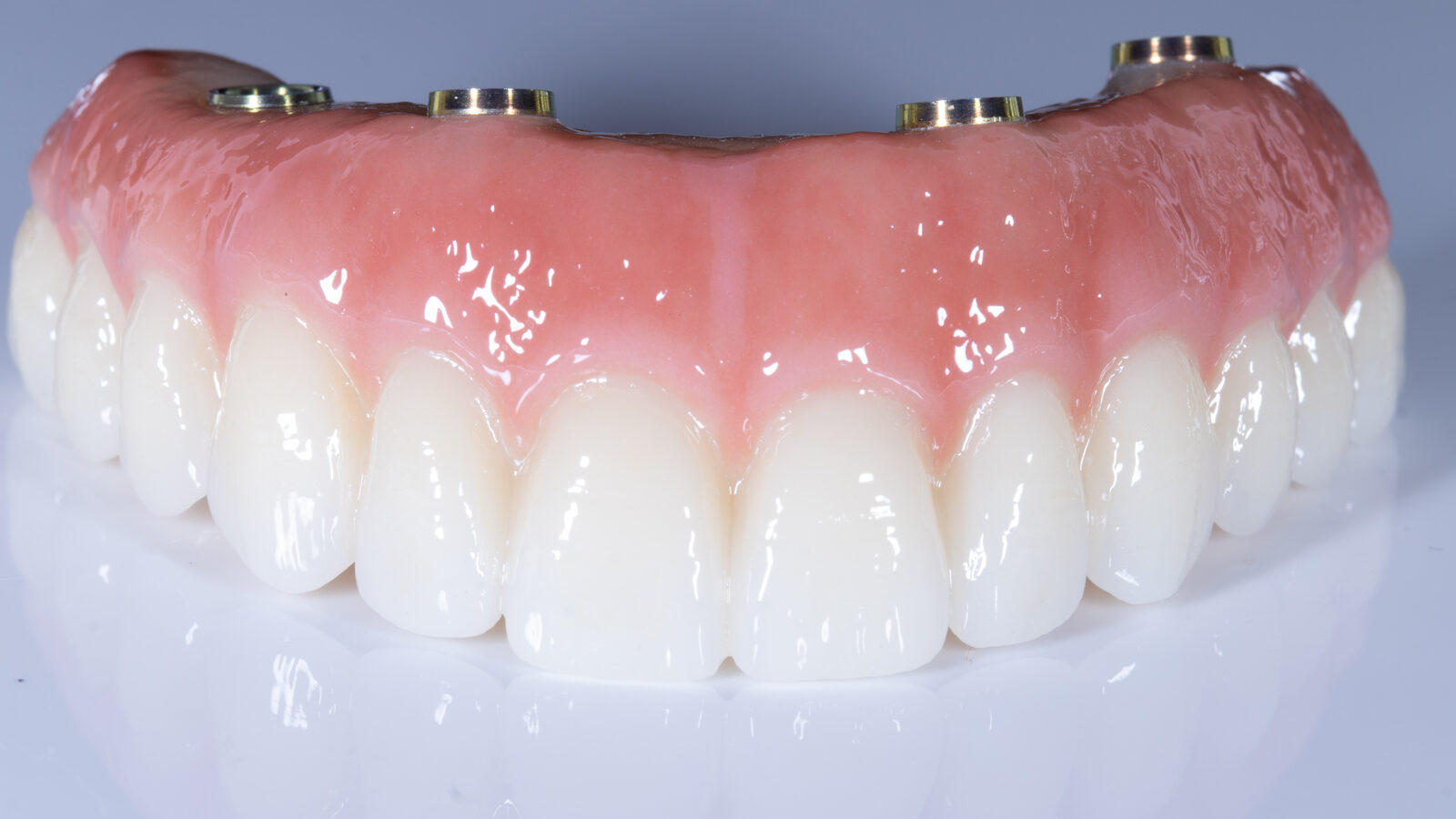
Figure 2. FP3 prosthesis: teeth plus a pink component that restores the lost gingival contour. Clinical image by Dr Miguel Mendes de Oliveira, published with patient consent.
FP1 vs FP3 at a glance
| Criterion | FP1 | FP3 |
|---|---|---|
| What it replaces | Teeth | Teeth and the contour of lost hard and soft tissues |
| Artificial gingiva | No | Yes, a pink ceramic or composite component |
| Anatomical conditions | Favourable or predictably reconstructable bone and soft tissues | Moderate to advanced tissue loss where prosthetic replacement is more predictable |
| Aesthetic transition | Teeth emerge from the patient's gingiva | The transition between natural tissue and the pink component must be planned outside the visible smile zone when possible |
| Lip and facial support | Depends on the patient's tissues and tooth position | Can replace lost volume and support |
| Implant position | Very limited margin for error at the gingiva-tooth transition | Must support the planned tooth position, prosthetic volume and hygiene access |
| Hygiene | Depends on the intaglio design, access and tissue transition; daily home care and professional maintenance are required | Requires access beneath the pink component; daily home care and professional maintenance are required |
| Phonetics | Often requires little adaptation, but depends on the design | May require adaptation to the prosthetic volume and contour |
| Typical indication | Favourable anatomy and a high aesthetic demand at the gingiva-tooth transition | Relevant tissue loss and a need to restore volume prosthetically |
Why can't everyone have an FP1?
FP1 is not simply the premium version of FP3. It requires a precise relationship between bone, soft tissue, implant position, tooth proportions, lip dynamics and hygiene access.
If there is insufficient tissue and it cannot be reconstructed predictably, forcing an FP1 design can result in excessively long teeth, black triangles, spaces that are difficult to clean, insufficient lip support and, in some cases, changes in speech.
Regenerative treatment can sometimes create the conditions for an FP1 result. In other cases, it would add surgery, time and risk without improving predictability. The decision must be individual.
The decision is made before surgery
The operating room is where the plan is executed, not where the prosthetic design should first be decided.
My planning sequence includes:
- Clinical examination and CBCT, to assess available bone, soft tissues and anatomical limitations.
- Clinical photography and facial and smile analysis, so that tooth position and tissue support are planned in the context of the face.
- Prosthetically driven digital planning, to test the intended result before making a surgical decision.
- An honest discussion of the alternatives, including whether FP1 is realistic or whether FP3 offers a more predictable path.
- A provisional restoration, and sometimes a second provisional, to evaluate aesthetics, phonetics, hygiene, tissue response and support before the definitive prosthesis is made.
My DME principle is simple: the minimum effective intervention is the one that achieves a biological, maintainable and facially coherent result. Doing less is not the objective. Doing only what is necessary for a predictable result is.
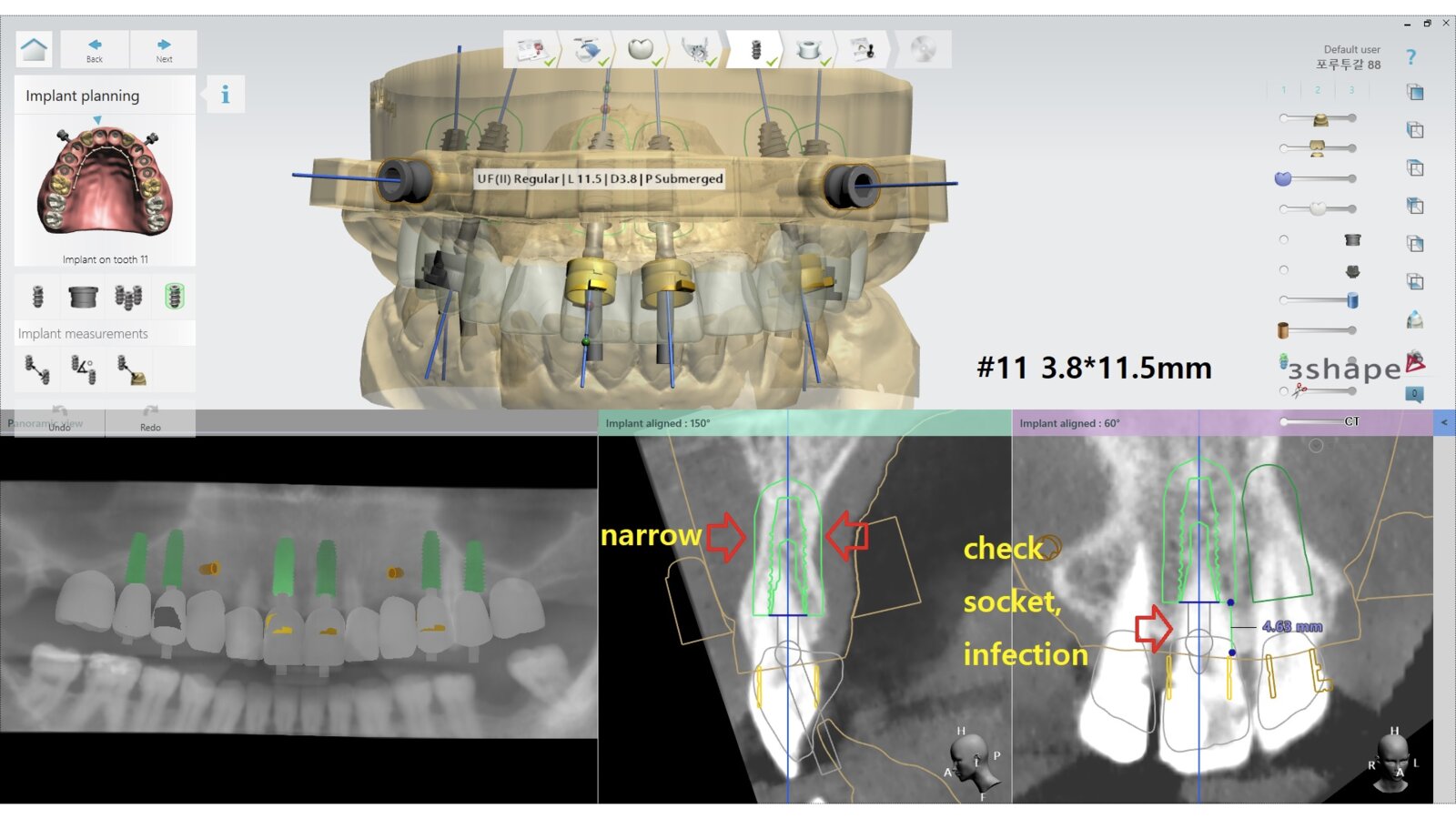
Figure 3. CBCT and prosthetically driven digital planning. The screenshot illustrates assessment of a narrow ridge, the condition of an extraction socket and the proposed implant dimensions and position. Planning image by Dr Miguel Mendes de Oliveira.
Frequently asked questions
Is FP1 better than FP3?
No. They are designed for different anatomical situations. The better prosthesis is the one that restores the necessary tissues, can be maintained by the patient and has been planned correctly for the anatomy.
What does FP1 mean?
FP means fixed prosthesis. In an FP1 design, the prosthesis replaces the visible crowns only and contains no artificial gingiva.
Can I have an FP1 if I have lost bone or gum tissue?
Sometimes. Regenerative treatment may rebuild sufficient volume, but this depends on the extent and position of the defect, the surgical risk and the predictability of the reconstruction. When reconstruction is not appropriate, FP3 may be the more predictable option.
Does FP3 look natural?
It can. The tooth proportions, pink material, surface texture and position of the prosthesis-to-tissue transition must be designed together. Facial and lip support matter as much as shade matching.
Which is easier to keep clean?
The hygiene protocol depends on the intaglio design, access and tissue transition; both require daily home care and professional maintenance. A water flosser, superfloss or interdental aids may be recommended according to the design. The clinical team must demonstrate the technique and review it over time.
Will my speech change?
Any full-arch prosthesis may require adaptation. FP1 often adds less palatal or gingival volume, while some FP3 designs may require a short adjustment period. Digital planning and the provisional phase help identify and correct phonetic problems.
How long does an FP1 or FP3 prosthesis last?
There is no universal lifespan for either design. Longevity depends on peri-implant health, hygiene, occlusion, materials, technical complications, patient habits and professional maintenance. These factors should be reviewed regularly rather than reduced to a single number.
Can an FP3 be converted into an FP1 later?
Only in selected cases. It may require additional hard- and soft-tissue reconstruction and a new prosthetic plan. The biological cost and predictability of that change must be assessed before treatment.
The right question to ask
Instead of asking, "Is FP1 better than FP3?", ask:
Which design best respects my anatomy and offers the most predictable, maintainable and natural result?
That question moves the decision away from labels and towards diagnosis.
View related full-arch clinical work, or arrange an individual assessment to understand which design may be appropriate for your anatomy.
View Clinical Cases → Book an Assessment →About the author
Dr Miguel Mendes de Oliveira is a dentist whose clinical work focuses on advanced implant dentistry, surgical periodontology and perio-prosthetic treatment, with particular experience in full-arch FP1 rehabilitation and tissue reconstruction.
Published: 23 September 2026
Last reviewed: 23 September 2026
The clinical photographs in this article are from the author's own cases and are published with patient consent. They are presented for education and do not guarantee an equivalent result in another patient.
Medical disclaimer: This article provides general information and does not replace a clinical examination, radiographic assessment or individual treatment plan. Indications, risks, alternatives and expected outcomes must be discussed with a qualified clinician.
References
- International Team for Implantology. The SAC Classification in Implant Dentistry, 2nd Edition. https://www.iti.org/resources/sac-classification/the-sac-classification-in-implant-dentistry-2nd-edition/
- American College of Prosthodontists. Position Statement: Maintenance of Full-Arch Implant Restorations. https://www.prosthodontics.org/about-acp/position-statement-maintenance-of-full-arch-implant-restorations/
- Bidra AS, Daubert DM, Garcia LT, et al. Clinical Practice Guidelines for Recall and Maintenance of Patients with Tooth-Borne and Implant-Borne Dental Restorations. https://pubmed.ncbi.nlm.nih.gov/26711219/
- Maintenance protocols for implant-supported dental prostheses. https://pubmed.ncbi.nlm.nih.gov/36535881/
- How often should implant-supported full-arch dental prostheses be removed for supportive peri-implant care to maintain peri-implant health? A systematic review. https://pubmed.ncbi.nlm.nih.gov/38501398/